The future of artificial intelligence is already taking shape: AI is moving from chatbots that answer questions to agents that complete tasks, from the cloud onto our phones and laptops, and into healthcare, search and everyday work. At the same time, governments are writing rules, and people are asking hard questions about jobs, trust and safety.
This guide explains where AI is heading, using recent data from sources like Stanford's AI Index, the World Economic Forum and Pew Research. You'll also find the key regulation dates and simple steps to prepare, whether you run a business or just want to keep your skills current.
Where AI Stands Today
AI use has grown fast. According to the Stanford AI Index 2026:
- Global AI adoption rose from 55% in 2023 to 88% in 2025.
- Generative AI reached 53% adoption within three years, faster than the internet or personal computers at the same stage.
- U.S. AI investment reached $285.88 billion in 2025.
So the question is no longer whether AI will matter. It's how it will change the way we work and live.
6 Trends Shaping the Future of Artificial Intelligence
1. AI agents that do tasks, not just answer
Today's chatbots mostly reply to questions. AI agents go further. They can plan steps and take actions, like booking a meeting, filling in a form or updating a spreadsheet. Expect them inside the apps you already use. The challenge is trust: agents need clear limits and human checks, especially when money or customer data is involved.
2. Multimodal AI
Newer AI models understand text, images, audio and video together. You can show AI a photo of a broken part and ask how to fix it, or have it summarize a recorded meeting. You can try simple versions of this today with free tools like our Speech to Text converter and AI Image Caption Generator.
3. Smaller AI that runs on your device
Not all AI needs giant data centers. Smaller, efficient models now run directly on phones and laptops. That means faster results, lower costs and better privacy, because your data doesn't have to leave your device.
4. AI in search
Search engines now show AI-written answers above regular results. People get quick summaries, then click through for detail. For businesses, clear, helpful content that answers real questions matters more than ever.
5. AI in healthcare
AI is helping doctors read scans, spot patterns and handle paperwork. The Stanford AI Index reports that the U.S. FDA approved 258 AI-enabled medical devices in 2025, bringing the total to nearly 1,400.
6. AI as a coworker
At work, AI is becoming a helper for writing, coding, research and customer support. The biggest gains come when people redesign their tasks around AI, not when they just add a chatbot on top of old processes.
How AI Will Affect Jobs
AI will change many jobs more than it removes them, but the shift is real. The World Economic Forum's Future of Jobs Report 2025 estimates that by 2030:
| Finding (WEF, 2025) | Figure |
|---|---|
| New jobs created | 170 million |
| Jobs displaced | 92 million |
| Net change | +78 million jobs |
| Share of job skills expected to change | Nearly 40% |
| Employers planning to upskill workers | 77% |
Early-career workers may feel it first. The Stanford AI Index found that headcounts for workers aged 22 to 25 fell in software development and customer support roles, while most older age groups grew. The takeaway: learning to work with AI is now a core job skill.
The Risks We Need to Manage
- Mistakes ("hallucinations"). AI can state wrong facts with confidence. Always check important outputs.
- Deepfakes and scams. Fake voices, images and videos make fraud easier.
- Privacy. Data you paste into AI tools may be stored or used for training, depending on the service.
- Bias. AI can repeat unfair patterns found in its training data.
- Energy use. Training and running large models uses a lot of electricity.
Problems are being tracked more closely. The Stanford AI Index counted a record 362 reported AI incidents in 2025. Public opinion is cautious too: a 2025 Pew Research survey found that 50% of U.S. adults are more concerned than excited about AI in daily life, up from 37% in 2021.
AI Rules: What's Happening in the EU and the US
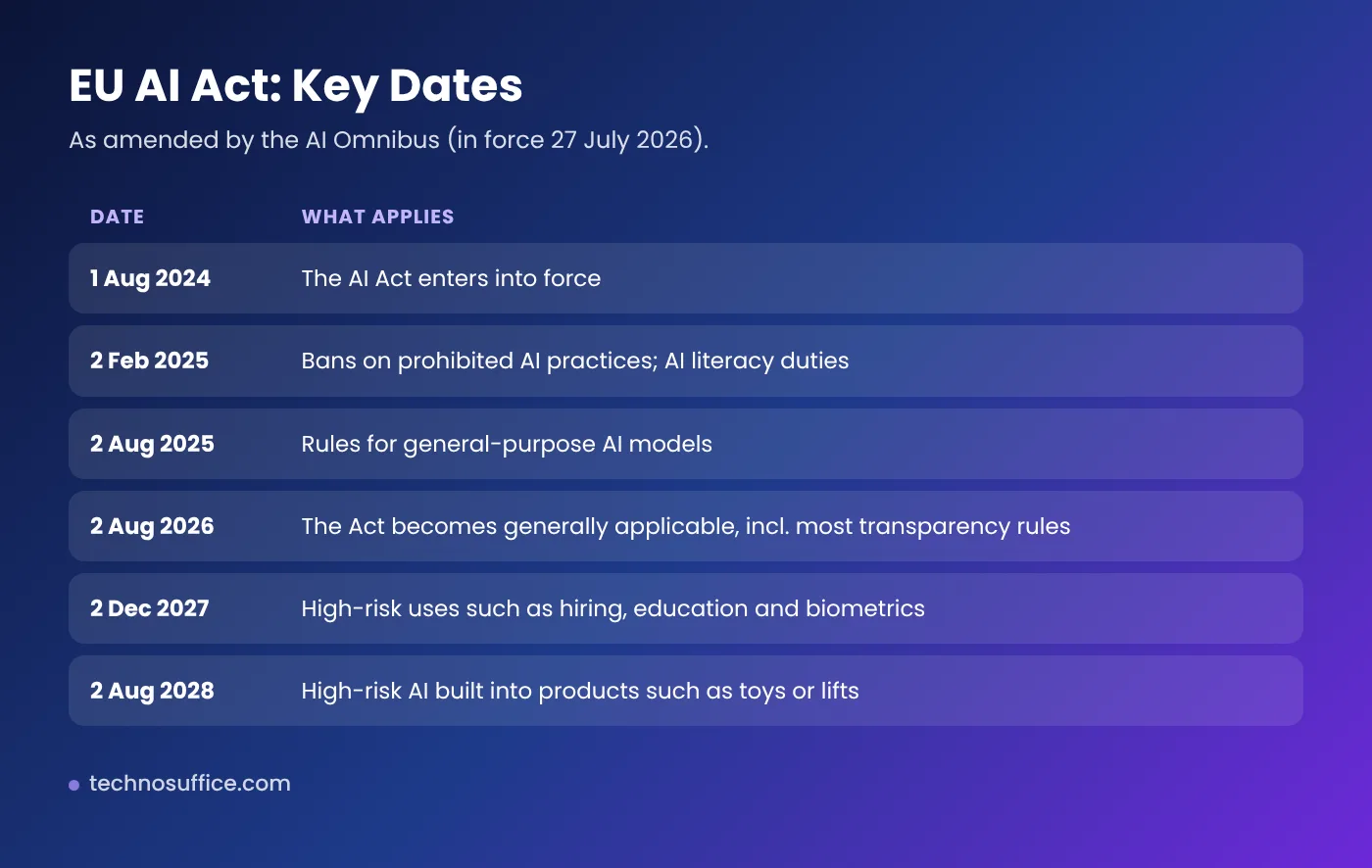
European Union. The EU AI Act is the world's first broad AI law. It applies in stages, and a July 2026 amendment pushed back the dates for high-risk systems:
United States. The U.S. has no single federal AI law. Instead, there's a mix of federal policy and state laws. Many companies use the NIST AI Risk Management Framework, a voluntary guide built around four functions: Govern, Map, Measure and Manage. Rules are changing quickly, so check current guidance before making big decisions.
What to Do Now: A Simple Checklist
For businesses
- Pick one or two tasks where AI can save real time, like summaries, support replies or data entry.
- Write a short AI policy: approved tools, what data must stay private, and who reviews outputs.
- Train your team to use AI well and to spot AI-powered scams.
- Keep a human in the loop for decisions about money, hiring or customers.
- If you sell in Europe, check whether the EU AI Act applies to you.
For individuals
- Use AI tools weekly so you understand what they can and can't do.
- Build skills AI struggles with: judgment, communication and deep knowledge of your field.
- Double-check facts before you share AI-generated content.
You can practice with free tools like our Text Summarizer, which turns long articles into key points in seconds.
Frequently Asked Questions
What will AI look like in 10 years?
No one knows for sure. Likely directions include AI agents handling routine tasks, AI built into most software and devices, and stronger rules on safety and transparency. Be wary of confident long-range predictions.
Will AI replace human jobs?
AI will replace some tasks and some roles, but the WEF expects more jobs to be created than lost by 2030. Most jobs will change, and people who use AI well will have an advantage.
What is agentic AI?
Agentic AI refers to systems that can plan and take actions toward a goal, such as completing a multi-step task, rather than just answering a single question.
Is AI a threat to humanity?
Experts disagree on long-term risks. Near-term risks are clearer: misinformation, scams, privacy problems, bias and over-reliance on wrong answers. Good rules and careful use help reduce them.
When does the EU AI Act apply?
It entered into force on 1 August 2024 and became generally applicable on 2 August 2026. Some rules started earlier, and high-risk rules apply from 2 December 2027 and 2 August 2028.
How can a small business start using AI?
Start small. Choose one repetitive task, try a trusted tool for a few weeks, measure the time saved, and set clear rules about data.
Conclusion
The future of artificial intelligence is practical and close at hand: agents that complete tasks, AI on our own devices, smarter search and real gains in healthcare. It also brings real risks and new rules. The best move is to start learning and testing now, with clear guardrails.
Want to see how AI could help your business? Read our guide to the future of IT services, or request a free quote to talk about adding AI features to your website or app.