The future of IT services is less about buying more technology and more about getting results from it. In 2026, the biggest shifts are AI agents that take on routine work, tighter control of cloud costs, "zero trust" security, closer checks on vendors, and IT contracts tied to outcomes instead of hours. For business owners, the goal is simple: adopt what saves time or cuts risk, and skip the hype.
This guide explains seven trends shaping the future of IT services, with current data from Gartner, Verizon, Flexera and NIST, and what you should do about each one.
The Big Picture: IT Spending in 2026
Businesses are still investing heavily in technology. In July 2026, Gartner forecast worldwide IT spending of $6.37 trillion in 2026, up 14.2%. Spending on IT services was forecast to grow 5.3%. Gartner also noted that this growth is not lifting every part of the market equally. Much of the money is going to AI infrastructure and software.
For a smaller business, the lesson is to spend where you can measure a return.
7 Trends Shaping the Future of IT Services
1. AI agents move from demos to daily work
AI agents are tools that can take actions, not just answer questions. They can sort support tickets, update records or draft reports. Gartner predicted that 40% of enterprise apps will include task-specific AI agents by 2026, up from less than 5% in 2025.
But be careful. Gartner also predicted that over 40% of agentic AI projects will be canceled by the end of 2027 because of rising costs, unclear value or weak risk controls. It warned about "agent washing," where old tools are rebranded as AI agents.
What to do: start with one boring, repetitive task. Set a clear success measure, like hours saved per week, before you buy.
2. Cloud cost control becomes a priority
Cloud bills keep growing, and AI workloads make them bigger. Flexera's 2026 State of the Cloud report found that wasted cloud spend rose to 29%, the first increase in five years, and 85% of organizations named managing cloud spend as a top challenge.
What to do: review your cloud and SaaS bills every quarter. Shut down unused servers, right-size the rest, and cancel apps nobody uses. Our cloud and DevOps team can run this review for you.
3. Zero trust security becomes the default
"Zero trust" means no user or device is trusted automatically, even inside your network. Every request is checked. NIST describes it as continuously evaluating and verifying conditions before granting access. The reason is clear: Verizon's 2026 Data Breach Investigations Report found that 31% of breaches started with attackers exploiting a vulnerability.
What to do: you don't need a big project to start. Turn on MFA everywhere, remove old accounts, give staff only the access they need, and patch software quickly.
4. Vendor and third-party risk gets real attention
The same Verizon report found that breaches involving a third party made up 48% of all breaches. Your security is only as strong as the vendors who touch your data.
What to do: list every vendor with access to your systems or customer data. Ask how they protect it, and remove access you no longer need.
5. IT contracts shift from hours to outcomes
As AI makes some IT work faster, paying purely by the hour makes less sense. More IT service providers are moving toward fixed-fee, managed and outcome-based pricing, where you pay for results like uptime, response time or a delivered feature.
What to do: when you renew an IT contract, ask for clear service levels, regular reports and fees linked to results.
6. Automation connects your apps
Many businesses still copy data between apps by hand. Low-code automation tools and small custom integrations can link your store, CRM, accounting and support tools. If your needs go beyond what ready-made connectors can do, read our guide on when custom software makes sense for a business.
What to do: find one manual handoff your team repeats every day and automate it.
7. AI governance and "shadow AI"
Staff are using AI tools whether or not the company approves them. Verizon reported that employee use of unapproved AI jumped from 15% to 45% of employees in a single year. That can put customer data and company secrets at risk. Meanwhile, the FBI's Internet Crime Complaint Center reported 22,364 AI-related scam complaints in 2025, with losses of nearly $893 million.
What to do: write a short AI policy. List approved tools, what data must never be pasted into them, and who to ask. Train staff to spot deepfake voice and email scams.
Your 90-Day IT Action Plan
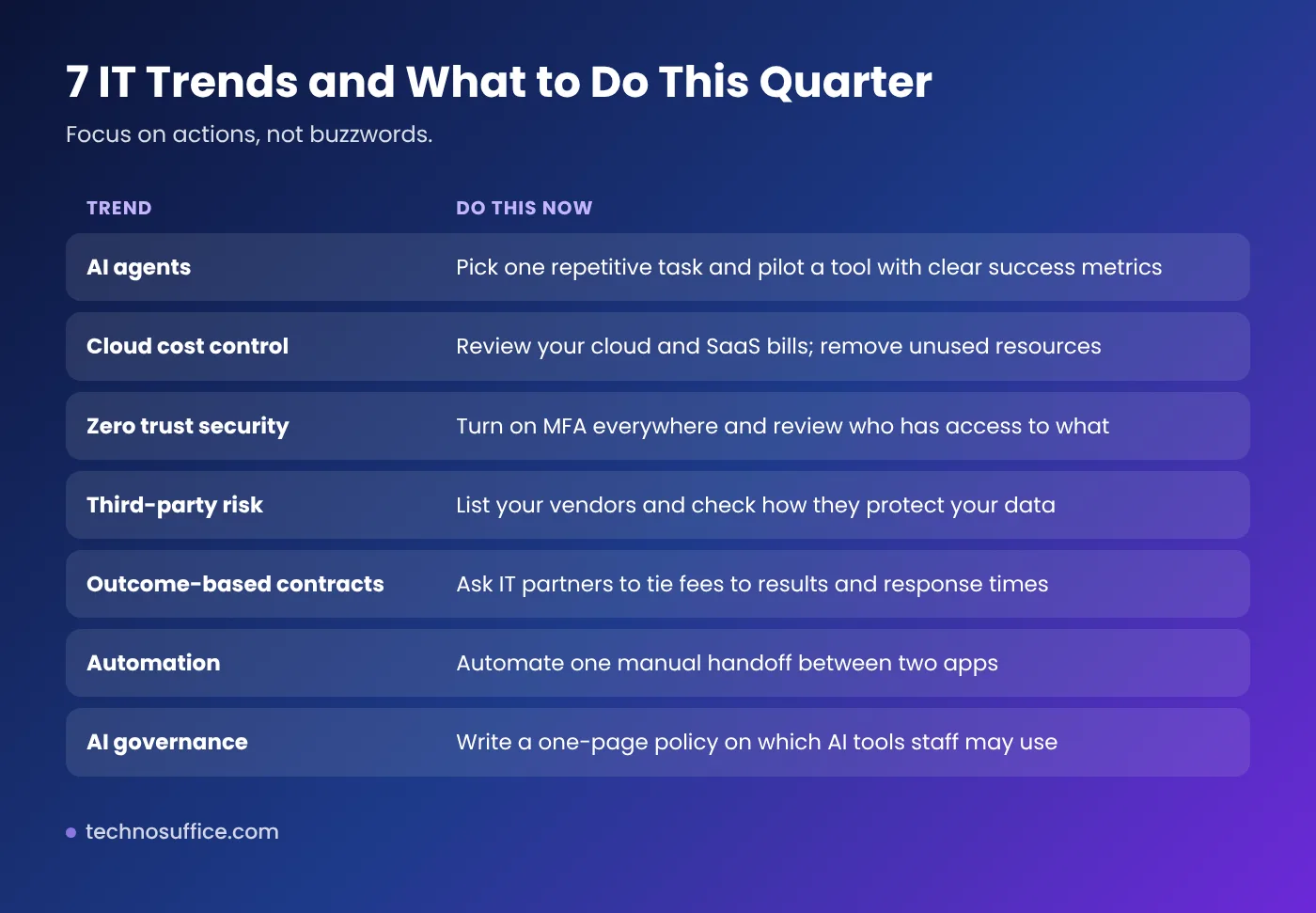
Don't try all seven at once. Pick the two that carry the most risk or cost for your business and start there. A simple rhythm:
- Month 1: turn on MFA everywhere, list your vendors and write a one-page AI policy.
- Month 2: review cloud and software bills and cancel what you don't use.
- Month 3: pilot one automation or AI tool on a single task and measure the time saved.
Trends You Can Safely Ignore (For Now)
| Trend | Why most small businesses can wait |
|---|---|
| Building your own AI model | Off-the-shelf AI tools cover most needs at a fraction of the effort |
| Quantum computing | Still early; no practical use for most businesses today |
| Metaverse storefronts | Little proven demand from customers |
| Replacing every tool at once | Big-bang changes add risk; improve step by step |
Will AI Replace IT Services?
Not likely. AI makes some IT tasks faster and cheaper, like writing simple code or answering common support questions. But it also adds new work: securing AI tools, connecting them to business data, checking their output and managing costs. The future of IT services is people and AI working together, with providers focusing more on planning, security and results.
For a wider look at where AI is heading, read our guide to the future of artificial intelligence.
Frequently Asked Questions
What is the future of IT services?
IT services are moving toward AI-assisted work, cloud cost control, zero trust security, closer vendor checks and contracts based on outcomes rather than hours.
What are the biggest IT trends in 2026?
AI agents, cloud cost management, zero trust security, third-party risk management, outcome-based IT contracts, automation and AI governance.
Which tech trends should small businesses pay attention to?
Focus on security basics (MFA, updates, backups), controlling cloud and software costs, and using AI features inside tools you already pay for.
What is zero trust security?
It's a security approach where no user or device is trusted by default. Every access request is checked based on identity, device and context.
Should I use a managed IT service provider?
If you don't have in-house IT staff, a managed provider can handle daily support, security and backups. Make sure the contract includes clear response times and data ownership terms. Our guide to IT solutions for small business covers how to choose.
Conclusion
The future of IT services rewards businesses that stay practical. Use AI where it clearly saves time, keep cloud costs in check, tighten security and expect your IT partners to deliver measurable results. Small, steady steps beat big, risky overhauls.
Want help putting these trends to work? Request a free quote and tell us where you'd like to start.