Custom web development means a developer designs and builds your website around your business, instead of starting from a ready-made template or website builder. Is it worth it? It depends. If you need a simple site fast, a good template is often enough. If your site must handle unique features, connect to other systems, or stand out from competitors, custom work usually pays off.
This guide gives you an honest comparison. You'll see the real pros and cons of each option, what the data says about speed and security, what drives cost, and a quick checklist to help you decide.
Custom Website vs Template: What's the Difference?
A template website uses a pre-designed layout. You add your logo, colors, text and photos. Website builders like Wix and Squarespace, hosted stores like Shopify, and WordPress themes all work this way.
A custom website is planned and built for your goals. The design, page layouts and features are made for your brand and your customers. It can still use a content management system (CMS) so your team can edit pages easily.
Templates are very common. According to W3Techs (October 2026), WordPress runs about 40% of all websites, Shopify about 5%, Wix about 4% and Squarespace about 2%. Many of those sites use themes. So a template is not a bad choice by itself. The question is whether it fits what you need.
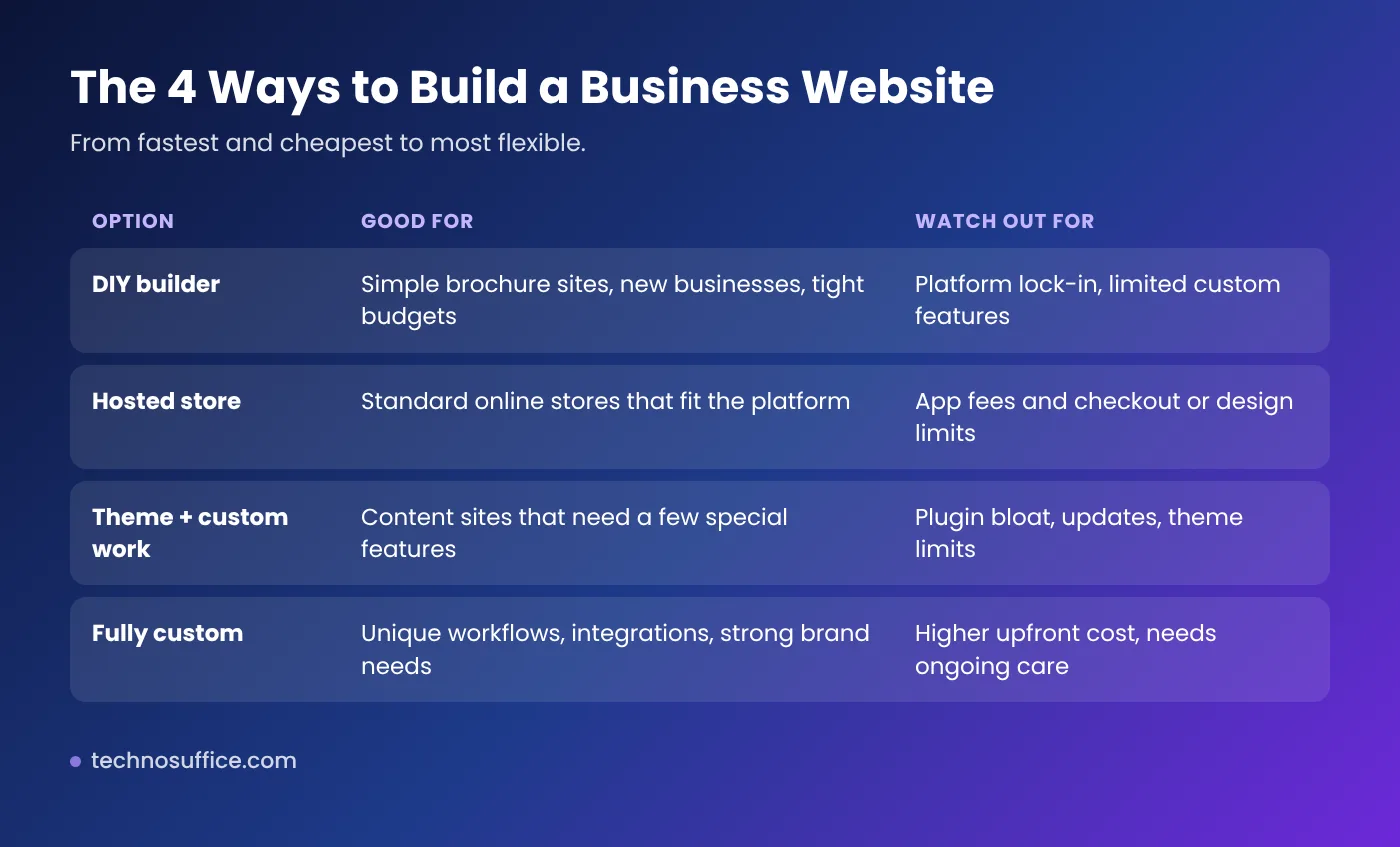
The 4 Website Options, From Simple to Fully Custom
It's not just "custom or template." Most businesses pick one of four levels:
| Factor | Template or builder | Custom web development |
|---|---|---|
| Upfront cost | Low | Higher |
| Time to launch | Days to a few weeks | Several weeks to a few months |
| Design | Shared with many other sites | Made for your brand |
| Features | Limited to the platform and its apps | Built for your exact needs |
| Integrations | Whatever the platform supports | Can connect to your CRM, ERP or APIs |
| Ownership and hosting | Often tied to one platform | You choose the host and own the code |
| Maintenance | Mostly handled by the platform | Needs a developer or support plan |
Benefits of Custom Web Development
1. A design built for your customers
A custom site starts with who your customers are and what they need to do. Page layouts, forms and calls to action are planned around those steps, not around a theme's demo content.
2. Features that fit your business
Booking flows, quote calculators, member areas, customer portals and special product options are easy to plan into a custom build. On a template, these often need several plugins or awkward workarounds.
3. Clean integrations
A custom website can connect directly to your CRM, inventory, payment gateway or internal software. Data moves automatically instead of being copied by hand.
4. Full control over SEO details
You control page structure, URLs, headings, schema markup and page weight. That makes it easier to follow SEO best practices without fighting a theme.
5. Freedom to move
With a custom build, you choose your host and own the code. Some builders don't allow this. Wix's own help center says your site must run on Wix's servers and can't be hosted elsewhere.
The Honest Drawbacks of Custom Websites
- Higher upfront cost. You pay for planning, design, development and testing.
- Longer timeline. A good custom site takes more time than filling in a template.
- Ongoing care. Someone must handle updates, backups and security.
- Quality depends on the team. A poorly built custom site can be slower and less secure than a well-made template.
Speed, Security and SEO: What the Data Says
Many agencies claim templates are always slow and insecure. The real picture is more mixed.
Speed. The 2025 Web Almanac found that sites on hosted builders like Duda and Wix passed Google's Core Web Vitals on mobile more often than WordPress sites did. Speed depends on how well a site is built and how many scripts and plugins it loads, not just on "custom vs template." A lean custom site can be very fast. So can a well-tuned builder site.
Security. The bigger risk is often add-ons. Patchstack's State of WordPress Security in 2026 report counted 11,334 new WordPress vulnerabilities in 2025, and 91% of them were in plugins. Fewer plugins and regular updates matter more than whether a site is custom.
SEO. Google doesn't rank sites higher because they are custom. It ranks helpful pages that load well and are easy to crawl. Custom work simply gives you more control over those details.
Want to see where your current site stands? Run it through our free Website SEO Checker and Page Size Checker to spot slow, heavy pages before you decide.
When a Template or Website Builder Is Enough
- You need a simple site with a few pages: home, services, about and contact.
- You're launching a new business and want to test the market first.
- Your budget is small and you can't fund ongoing maintenance yet.
- Your online store fits the standard features of a platform like Shopify.
Starting with a template and going custom later is a smart path for many small businesses.
What Drives the Cost and Timeline of a Custom Website?
We won't quote made-up price ranges, because every project is different. These factors make the biggest difference:
- Number of unique page types (not total pages).
- Custom features like booking, calculators, portals or logins.
- Integrations with CRMs, payment systems or inventory tools.
- Content migration from an old site, including redirects to protect SEO.
- Content readiness. Projects move faster when text and photos are ready.
- Accessibility and performance goals you set for the build.
- Hosting and support after launch.
To see what happens at each stage, read our step-by-step website development process guide.
Signs You've Outgrown Your Template
- You pile on plugins or apps to get basic features working.
- Your site is slow, and the theme won't let you fix the cause.
- You can't connect your site to the tools your team uses.
- Your brand looks like every competitor that bought the same theme.
- You want to change hosts but your platform won't let you.
Quick Checklist: Is Custom Web Development Right for You?
Answer yes or no. If you say yes to three or more, custom work is worth exploring.
- Do you need features that no template or app handles well?
- Does your website need to connect to other business systems?
- Is your brand a big part of why customers choose you?
- Do you expect your site's needs to grow a lot in the next three years?
- Do you want full ownership of your code and hosting?
- Do you have a budget for upkeep after launch?
Frequently Asked Questions
Is a custom website worth it for a small business?
It is worth it when your site needs unique features, integrations or a strong brand presence. For a simple brochure site, a quality template is often the smarter choice at first.
Is a custom website better for SEO?
Not automatically. Google ranks helpful, fast, well-structured pages. Custom web development makes those details easier to control, but a well-optimized template site can rank well too.
How long does it take to build a custom website?
It depends on page types, features, integrations and how fast content and feedback come in. Simple custom sites take weeks; complex ones take months.
Why do custom websites cost more?
You pay for planning, unique design, development and testing for your business alone. A template spreads those costs across thousands of buyers.
Can I start with a template and switch to custom later?
Yes. Many businesses do this. Plan your content and URLs carefully so you can redirect old pages and keep your search rankings during the move.
Should I use Wix or Squarespace or hire a web developer?
Use a builder if you need a simple site quickly and can manage it yourself. Hire a developer if you need custom features, integrations or full control over hosting and code.
Conclusion: Pick the Simplest Option That Meets Your Goals
Custom web development is worth it when your website must do more than a template allows: unique features, deep integrations, a standout brand or full ownership. If you don't need those yet, a well-built template is a fine start. Whatever you choose, keep your site fast, secure and easy to update.
Want an honest opinion on your project? Explore our web development services or request a free quote. We'll tell you if a template will do the job.